We've heard this before
The case against comprehensive AI regulation has been made before - almost word for word - about electricity. Why "too complex to regulate" is an argument with history.

At a recent AI and law conference in New Zealand, a familiar argument sometimes surfaced, on the panels and in coffee discussions. The technology is moving too fast. The architecture is too complex. Regulation will stifle innovation. We don’t yet understand it well enough to write the rules. It is a sincere argument, made by intelligent people. However, it is missing useful lessons from history – from other moments when general-purpose technologies were reshaping society and it seemed too soon, or too complex, to regulate. It was wrong then, for reasons that matter now for AI.
When it comes to regulating AI, the common analogy in AI governance circles is the aviation industry or the car industry – Anthropic CEO, Dario Amodei used it in an April 2026 Financial Times interview; it’s mandatory, third-party-assessed, and built around safety standards. It is an appealing comparison and feels reassuring: regulation and innovation can coexist; we have done this before. But how long should that take? And what harm will we tolerate while we figure that out?
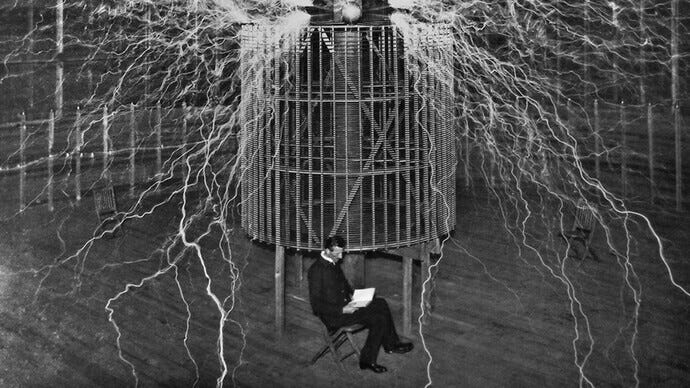
Nikola Tesla staged this photograph in 1899 to reassure investors that someone capable was in charge of the forces he had unleashed. The wonder was performed. The governance was not.
We all know electricity as an everyday technology that is highly regulated - but that is not how it started. I wondered at how that all played out and if it could offer any lessons to help us with the rapidly developing AI developments today. I knew that electricity emerged through private innovation – closely associated with figures like Edison – that it was dangerous technology (electrocutions) and that it was in both public and private use when it was introduced into everyday life. So, I began reading about the history of electricity regulation; the War of the Currents, UK regulation and also New Zealand history. It’s been fascinating. The opening paragraphs of key text books about electricity in the 1880s could have been written about AI (see notes section).
As at early 2026, the regulation of AI is like the regulation and governance of electricity in the late nineteenth and early twentieth century – patchy, inconsistent, and often reactive regulation, despite electricity being obviously dangerous (including killing people through electrocution in public and private places overseas). There was real danger from high voltage lighting systems, exposed wiring and insulation problems. There were also adverse impacts on electrical infrastructure and equipment, as inconsistent voltages, poor insulation, and incompatible systems caused damage to machinery and supply networks. AI presents a similar challenge. Its risks are not only external. Left unstructured, it can also corrupt the information environment on which it depends: AI-generated content is already polluting the web at scale, degrading the quality of the data on which future models may be trained.
Electricity arrived in streets and homes before anyone had agreed what to do with it at a community or societal level. It could literally kill people and was everywhere - in theatres, on public thoroughfares, in the buildings where ordinary people worked and lived. The public fear of electricity was real. One of the most shocking cases was that of John Feeks, a Western Union lineman working in downtown Manhattan on 11 October 1889. What happened is grimly described in his obituary:
A telegraph lineman named John Feeks met a horrible death on Chambers street, New York city, last Friday afternoon from contact with an electric-light wire. He presented a terrible sight, as he died on the network of wires in mid-air, .... The accident, occurring in one of the busiest parts of the city, was witnessed by a large number of people.
The man’s body lay limp and motionless over the mass of wires attached to the cross-trees of the pole. ... The body lay where it was until firemen went to the factory and had the current turned off. ... Hundreds of people stood shivering as they looked at the awful sight. No one dared to go near. Even the firemen’s faces blanched with horror. The body of the lineman could not be taken down from the wires for half an hour. ~ From John Feeks obituary

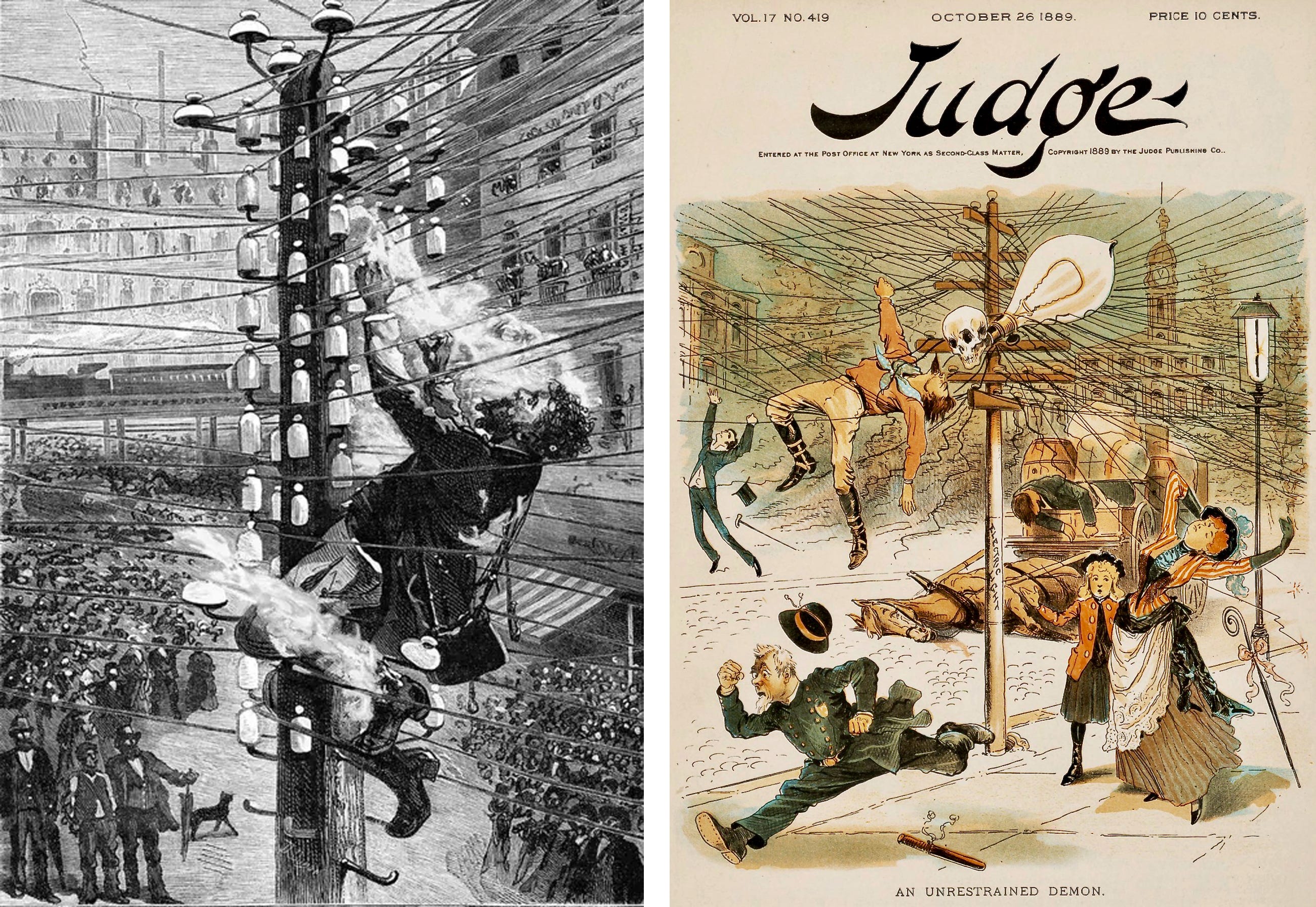
The public reaction was one of horror and outrage. Citizens began chopping down electricity poles. Newspapers called the wires a menace to every man, woman, and child in the city. And yet meaningful, nationally consistent safety regulation was still many years away.
The evidence of danger was not being hidden. In December 1889, Harper’s Weekly cited Alexander Welsh, an assistant to Thomas Edison, speaking directly to the peril on New York’s streets:
“Wherever you see the big white electric light, with its carbons burning, you may know that death lurks overhead. Nearly every wire you see in the open air is thick enough and strong enough to carry a death-dealing current. As things are at present, there is no safety, and danger lurks all around us.”
– Alexander Welsh, assistant to Thomas Edison, cited in Harper’s Weekly, 14 December 1889
That same issue of Harper’s Weekly made clear that the failure was not one of knowledge but of governance and political will; the danger was visible, but the response was delayed. The Grand Jury had formally declared New York’s Board of Control – which had oversight of electric wires – to be both grossly negligent and incompetent. The editorial conclusion was pointed:
“If this city is menaced every moment with deadly electric wires, it is because it chooses to be menaced. It is too lazy or too busy to care to protect itself.”
– Harper’s Weekly, 14 December 1889
Similarly, in New Zealand, electricity arrived before there were settled, national standards for how it should be governed. By the early 1880s, private industrial sites – including factories in Dunedin – were already experimenting with electric lighting systems. In 1888, Reefton – a West Coast gold rush town whose mining wealth had generated both the capital and the appetite for modern infrastructure – became the first town in the Southern Hemisphere to establish a public municipal electricity supply, ahead of many suburbs in London, New York City.
The early development of electricity in New Zealand was not centrally coordinated but emerged through a patchwork of local schemes run by boroughs, private companies, and regional initiatives. While some enabling legislation existed, detailed standards and consistent regulation developed only decades later, meaning electricity was introduced into communities in uneven ways. Given the power of electricity, and the documented harm happening overseas, it is striking that stronger central controls did not occur earlier – or immediately.
New Zealand was paying close attention to what was happening overseas. For example, in April 1880, the Ashburton Herald carried an account from Birmingham of the dangers of electricity killing a member of an orchestra in Holte Theatre:
BOTTLED LIGHTNING. A shocking story comes from Birmingham, which shows how careful people ought to be in using the electric light. It appears that at the Holte Theatre several designs are lighted by a number of electric lamps. A M. Bruno, one of the orchestra, although warned not to do so, took hold of the brass connections when the lamps were not in use, and thus received the full force of the current generated by a powerful battery which supplies all the lights in the buildings and grounds. He was unable to disengage himself, and pulled the wire down. When released he was insensible, and though restoratives were applied, he died in about half an hour. London gas is certainly bad enough, but it is better than what an irreverent young man called bottled lightning.
When New Zealand Parliament’s buildings dramatically burned down on 11 December 1907, electricity had been embedded in public infrastructure – but detailed, consistent safety standards had still not yet been established. The cause of the fire was never definitively determined, though an electrical fault was among the possibilities considered (a working theory was electrical wiring in the interpreters’ room):
A great library bonfire was narrowly avoided in 1907, when fire swept through Parliament Buildings in Wellington. At 2 a.m., Parliament’s nightwatchman thought he heard rain on the roof, but when he went to check found that a substantial blaze had broken out…
The fire, probably started by faulty electrical wiring in the ceiling of the interpreters’ room, spread rapidly through the old wooden parts of the buildings and then into the 1880s masonry additions. By 5 a.m. it had destroyed Bellamy’s restaurant and firefighters were battling desperately to save the library.
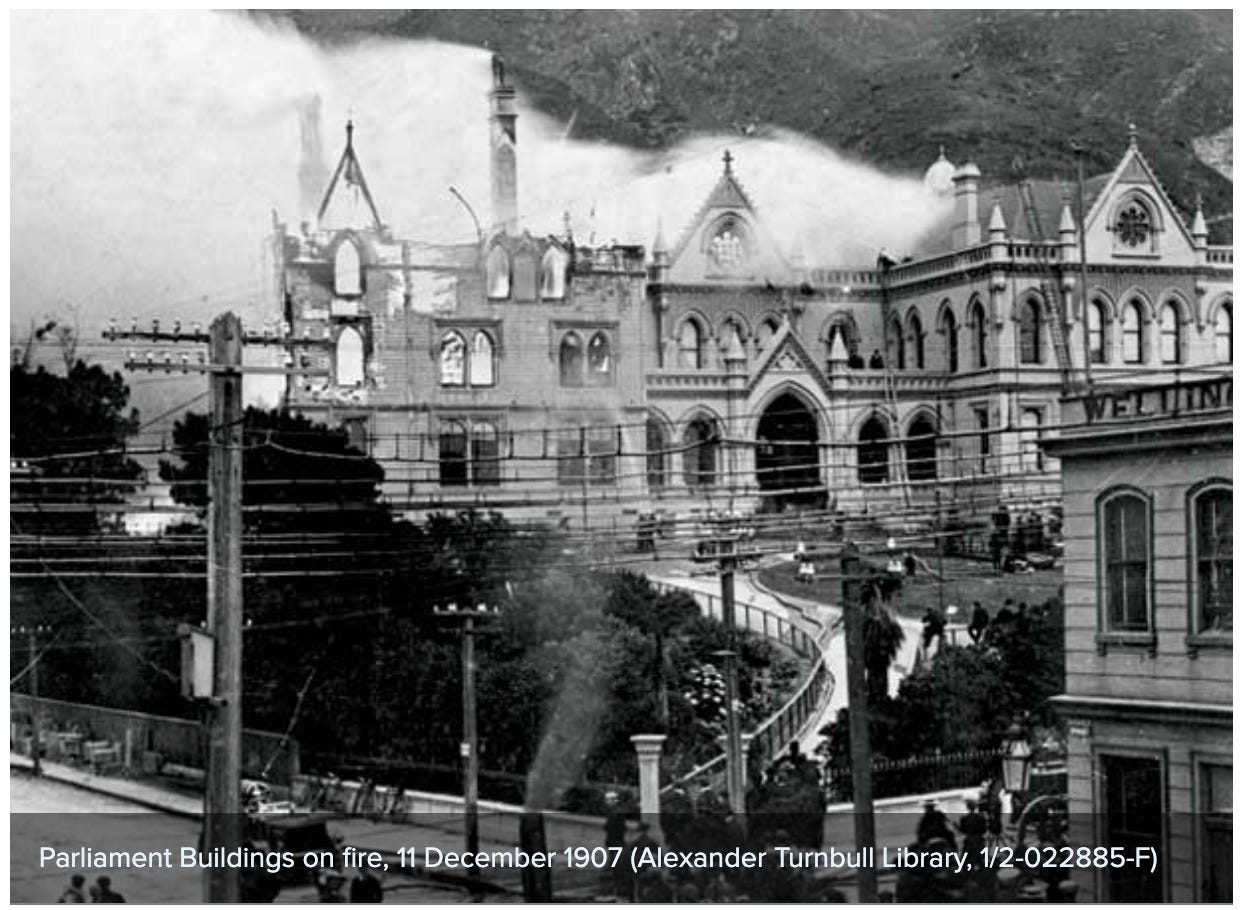
It is interesting that although comprehensive electrical regulation emerged in the years that followed it did not occur rapidly. If the destruction of Parliament’s own buildings by (potential) unregulated electrical infrastructure couldn’t accelerate the political will to act, what would it take? (the first set of national, mandatory government regulations were the 1927 Electrical Wiring Regulations – some 20 years after the fire at Parliament. Prior to that were regulations issued by the Fire Underwriters Association of New Zealand).
The leading commercial voices were arguing internationally, with considerable sophistication, that electricity was too dynamic, too technically complex, and too varied across competing systems for standardised governance to work. And so, it took decades to regulate, long after the harms had become undeniable.
The War of the Currents – Edison versus Westinghouse, DC versus AC – is a fascinating history in its own right. But the point that matters here is simpler: the arguments against regulation sounded principled, but the motivations behind them were not purely so. The public argument (too complex, too dynamic) and the private interest (protecting market position) were different things, even when they pointed in the same direction.
Sound familiar? But can anyone in New Zealand imagine living without electricity being properly regulated? “Too complex to regulate” is almost always a temporary claim –and it is rarely a neutral one. It tends to align with the interests of existing power holders, whose priorities do not always coincide with the public good.
What changed the electricity debate was not that the technology stopped moving. It was that the harms became undeniable and politically intolerable; electrocutions, fires, monopoly pricing, unequal access. The question of who was accountable when things went wrong could no longer be deferred.
And crucially, the answer didn’t require regulators to master the physics of alternating current. It required them to govern the conditions under which electricity was made available to people – safety standards, market access, professional obligations, accountability and also operational frameworks.
Whether the model itself requires regulation is a question for technologists, policymakers, and those with far deeper expertise in AI architecture than most of us possess. What is clearer is that we need to govern the conditions under which AI is deployed – who is responsible when it causes harm, what professional obligations apply when it is used to give advice, how we ensure it treats people fairly, and what transparency obligations attach to consequential decisions.
Of course, the analogy between electricity and AI isn’t perfect. The harms from AI are rarely visible in the way a body on an electrified wire was visible. They tend to accumulate quietly, falling on people who lack the power or resources to identify, let alone challenge, what has happened to them. Deepfakes - AI-generated images that place real people, disproportionately women and girls, into sexually explicit scenarios without their consent - are a clear example of this kind of serious harm. These images are being created and distributed at scale and our existing law cannot currently address them as they were not designed for AI-generated content (see below note for Bill introduced into Parliament in 2025 to address this gap).
Australia’s Robodebt scheme is a serious warning lesson for this region as an example of systemic institutional harm (it was not AI but an automated decision-making system). A government algorithm unlawfully raised debts against more than 430,000 welfare recipients – wrongly recovering over $750 million from some of the most financially vulnerable people in the country. The scheme ran for three years before litigation forced it into the open. Letters were read into a Senate inquiry from mothers whose sons had taken their own lives after receiving debt notices. The algorithm was not sophisticated and the harms were, in retrospect, entirely predictable.
As at 2026, New Zealand has adopted a light-touch, principles-based approach to governing and regulating AI – grounded in the OECD AI Principles and existing regulatory frameworks (link). Whether that reflects considered pragmatism or a failure of ambition and leadership is itself a question worth asking. There are clear parallels with the decades it took for electricity to be governed effectively for risk in New Zealand.
There is a further question: who builds, owns, and controls these systems. That is not simply a matter of regulation. It is a question of infrastructure investment, control, and political economy. The history of electricity shows us that regulation was only part of the story. Public investment played a central role in shaping how the system developed, who it served, and who benefited. That is a conversation New Zealand has barely begun to have in the context of AI. But that is for another piece.
Principles-based governance places significant weight on professional responsibility and organisational accountability. For much AI use, that may be appropriate. But it also means the hard work of defining what “responsible” actually requires falls largely to individual organisations – without the clarity that specific regulation and legislation could provide. For systems that make or substantially influence decisions about people’s health, their employment, their access to services –the classic New Zealand “she’ll be right” approach is not good enough. The harms in these contexts are not abstract. They fall on real people, often those least able to challenge an automated decision that has gone wrong or if their personal information falls into the wrong hands.
New Zealand has had the benefit of watching other jurisdictions grapple with high-risk AI in real time. We have the EU’s framework as a reference point. The EU has developed legislative and regulatory architecture to govern AI in the best interests of its people. The EU AI Act – whatever one thinks of its architecture – has done serious, well-resourced work on identifying AI systems that carry unacceptable or high risk, including specific uses of AI in areas such as clinical decision-making, employment and hiring, credit scoring, and law enforcement.
High risk AI systems are not hypothetical concerns. They are already being deployed here, in New Zealand workplaces and institutions, largely without specific regulatory oversight and they are causing legitimate concern. And this is where New Zealand needs to have a serious conversation about the need move with urgency in regulating AI, especially high risk AI systems.
Calls have been made by senior AI governance and technology experts in New Zealand to have a bipartisan approach to a risk-management based approach to regulating AI. This could be through either “new overarching AI legislation or a revision of existing laws to ensure they are fit for purpose” (link).
We do not need to learn this the hard way. The legislative and regulatory work in governing AI has been done by the EU – we need the will to use it.
The pace of AI deployment should argue for more urgency in governance conversations, not less. The question is whether we act on that knowledge, or wait until the harms force the issue, as they did, for a generation, with “bottled lightning”. History shows us waiting to govern a powerful and transforming technology is not a neutral or cautious option – it is one that fails to manage risk and prevent harm to the people.
Notes
Deepfakes:
NZ proposed legislative reform: In 2025, ACT MP Laura McClure’s Deepfake Digital Harm and Exploitation Bill was drawn from the members’ ballot, seeking to close this gap by amending both the Crimes Act 1961 and the Harmful Digital Communications Act 2015 to explicitly include AI-synthesised images – but as of the time of writing, it has not yet secured government support for urgency.
Little Witch:
I enjoyed finding this piece in the Bay of Plenty Times of 7 July 1881, where Sir William Thomson – one of the great physicists of the age – described a new portable electrical storage battery as “a little witch” containing “tremendous power stored within its narrow limits.”
The paper noted that Custom House officials had treated the device with the same suspicion as dynamite and dangerous explosives generally. The wonder and the unease were always present together. That feels very familiar.
Early 20th century US comments about electricity
I also came across this link about the arrival of electricity in American life in the early twentieth century: (link). I was struck by how familiar the language of transformation sounds. Speaking at a Rural Electrification Administration celebration in 1938, President Franklin Roosevelt declared:
“Electricity is a modern necessity of life, not a luxury. That necessity ought to be found in every village, in every home and on every farm in every part of the United States.”
A Sears catalogue from 1917 put it: “Use Your Electricity For More Than Light.” I particularly enjoyed this excerpt about the promise re domestic tasks and electric appliances such as irons, vacuums and washing machines making cleaning easier, yet:
Time spent doing domestic tasks didn’t seem to decline, however, as standards of cleanliness rose and fewer families employed domestic servants.
AI is being marketed, in part, as relief from cognitive drudgery – the routine, the repetitive, the time-consuming. That may well be true. But the history of electricity suggests we should ask a harder question: relief for whom, and at what cost, and will the time saved simply be filled with new demands we haven’t yet named?
NZ textbooks on the history of electricity
Reading the history of electricity in New Zealand, what strikes me is how familiar the governance challenge sounds. These passages are pulled directly from key New Zealand textbooks on the history of electricity. You could substitute “AI” for “electricity” and they would be entirely relevant to today’s discussions.
Martin, J. E. (Ed.). (1991). People, politics and power stations: Electricity in New Zealand 1880–1990. Bridget Williams Books / Electricity Corporation of New Zealand.
“The history of the planning for electricity supply and the construction of power stations by government in New Zealand tells us much about our past and reflects the kind of society that has evolved in this country. It demonstrates the profound impact of technological innovation and enterprise in a country as far away as it could be from the centres of such developments in Europe and the United States. This history documents the crucial role played by New Zealand’s engineers in developing solutions to the complex issues of electricity generation.
The electricity-generating industry is a vital part of the country’s economy. Investment in generating plant has from the beginning been a crucial aspect of the government’s role in providing an infrastructure. It comprises a substantial proportion of national investment and makes a central contribution to economic development. This in itself has assured the industry of a key role in the economy and in political and philosophical debates about the kind of society we want. This story is integral to New Zealand’s development as a whole.” - Preface, p7
Rennie, N., & Electricity Supply Association of New Zealand. (1989). Power to the people: 100 years of public electricity supply in New Zealand (p. 33). Electricity Supply Association of New Zealand.
Rennie described the early development of the electricity system as seeing the state, local bodies, and private enterprise “jockeying for position,” with the gas industry “either shouting from the sidelines, or actively joining in the race.” He noted that the way different electrical supply systems developed throughout New Zealand “aptly illustrates the issues politicians at all levels faced and the decisions the developing technology forced them to make.”
That sentence could have been written last week. About AI.
NZ Parliament fire of 1907
The cause of the New Zealand fire of Parliament in 1907 was never definitively determined. Contemporary reporting, including the Otago Witness of 18 December 1907, noted the source was unknown. Manatū Taonga’s NZ History records the probable cause as faulty electrical wiring in the ceiling of the interpreters’ room.
Death Current & the electric chair
In the late 1880s, one of the great industrial battles of the modern era was playing out on the streets and in the newspapers of America. It became known as the War of the Currents: Edison’s direct current system against the alternating current system being developed commercially by George Westinghouse, using key patents associated with Nikola Tesla. The stakes were enormous: whoever prevailed would help shape the electrical infrastructure of the industrialising world.
Edison’s DC system was under pressure. AC was better suited to long-distance transmission because voltage could be stepped up and down using transformers, and Westinghouse’s system was winning important contracts. The response from Edison’s side was not only technical or commercial. It was also public and political. Anti-AC campaigners, most notably Harold P. Brown, staged demonstrations in which animals were electrocuted with alternating current, with assistance from Edison’s laboratory and allies, as part of a campaign to present AC as uniquely dangerous.
The campaign went further. When New York State sought a method of execution thought to be more humane than hanging, Edison supported the use of alternating current and helped associate AC – and Westinghouse’s system in particular – with the electric chair. The first execution by electric chair used a Westinghouse AC generator. The commercial logic was clear enough: if AC became associated in the public mind with state killing, it might become politically and commercially toxic.
On 6 August 1890, William Kemmler became the first person executed in an electric chair. The execution was prolonged and gruesome; the current had to be applied twice.
Edison lost the larger battle anyway. AC became the dominant system. The current once presented as deadly now powers homes, hospitals, and schools across the developed world. It is a useful reminder that the most alarming arguments about a technology are not always made in the public interest.
References
Complete Dario Amodei Financial Times (paywall) – also referred to here.
Amodei, D. (January 2026 ). The adolescence of technology: Confronting and overcoming the risks of powerful AI.
Gosavi, J. (2026, March 28). More complaints arise about Woolworths’ “laughable” use of AI personality analysis in job interviews. NZ Herald
Walton, F. (2026, March 27). Jobseekers and advocates disturbed as companies screen applications with AI. Radio New Zealand.
Bottled Lightning. (1880, April 29). Ashburton Herald, III (637), p. 2.
‘Bottled Lightning’ and ‘Little Witch’ (1881, July 7). Bay of Plenty Times, X(1061), p. 3.
Falconer, I. (2019, October 1). Tesla versus Edison: Lessons from the AC/DC war. Physics World.
Ministry of Business, Innovation and Employment. (2025, July 8). New Zealand’s strategy for artificial intelligence: Investing with confidence. New Zealand Government.
Lensen, A., McGavin, C., & Mudgway, C. (2026, April 26). A call to the NZ Parliament to regulate AI [Open letter]. Regulate AI NZ.
Otago Witness, Issue 2805. (1907, December 18). Great fire in Wellington: Parliamentary buildings destroyed. Both houses in ruins. Otago Witness, p. 31. Papers Past, National Library of New Zealand Te Puna Mātauranga o Aotearoa.
Manatū Taonga Ministry for Culture and Heritage. (2014, October 24). Parliament buildings: Disasters. NZ History.
Manatū Taonga Ministry for Culture and Heritage. (2020, September 23). Parliamentary library escapes fire. NZ History.
Manatū Taonga Ministry for Culture and Heritage. (2020, October 30). Sound: The 1907 fire at Parliament buildings. NZ History.
Petrajane. (n.d.). Fire at Parliament 1907. DigitalNZ.